
How Long Does a Surge Protector Last?And the Warning Sign Most People Miss
By The Computer Solution · July 7, 2026
TL;DR
- Surge protectors wear out. Most last about three to five years, less if you get a lot of storms.
- When one wears out, it still powers your stuff. So it looks fine, but it is not protecting anything anymore.
- A power strip is NOT a surge protector. And a surge protector will NOT stop a lightning strike. People mix these up all the time.
- You cannot really test one at home. Do not trust the little "protected" light. Go by its age, the storms it has been through, and any damage you can see.
- Replace it right away after any lightning or big power surge. When you buy one, do not go below a 3,500 joule rating.
- Never overload one, and never plug one strip into another. Both can start a fire. Big things like space heaters go straight into the wall.
- Smart tip: when you buy one, write down when its warranty ends. Set a reminder to replace it on that day.
Here in Southwest Colorado, our summer storms roll in most afternoons. The thunder rattles the windows, and lightning lights up the sky. It is beautiful. It is also the exact kind of weather that wears out your surge protector. That is the little strip on the floor that all your cords plug into. Most people think it will protect them forever. It will not. And here is the scary part: when it stops working, it gives you no warning at all. Let me explain.
First, two things almost everyone gets wrong
Before we talk about how long they last, let us clear up two big mix-ups. I see them all the time. They are easy mistakes to make. But they leave people thinking they are safe when they are not.
1. A power strip is not a surge protector. They look almost the same: a bar with a row of outlets. So people figure they are the same thing. They are not. A plain power strip just turns one outlet into six. It does nothing to stop a power surge. A real surge protector has parts inside that soak up those surges before they reach your stuff. Here is the easy check: if it does not say "surge protector" on it and show a joule number (more on that word later), it is just a power strip. It is protecting nothing.
2. A surge protector will not stop a lightning strike. This one goes the other way. A surge protector is made to handle the small power spikes that come through your wires every day. It is not made for a direct lightning hit. Lightning carries way too much power for any little plug-in strip to stop. So yes, a surge protector guards against the everyday stuff. But it is not a shield against a bolt of lightning. That matters a lot during storm season.
They’re consumable, not forever, meaning they do wear out
A surge protector has a part inside that soaks up extra power. That part can only take so much. Every surge it stops wears it down a little. That includes the big storm surges and the tiny ones you never even notice. Over time, it just gets used up. Most plug-in ones last about three to five years. A run of stormy summers like ours can use them up faster. Think of it like tires or brake pads. It is not a buy-it-once-and-forget-it thing.
The quiet way they fail (this part matters most)
Here is the part that catches smart, careful people. When a surge protector wears out, it does not tell you. It still sends power to everything plugged into it. Your lamp still turns on. Your computer still starts up. So everything looks fine. But the protection inside is gone. In plain terms, a dead surge protector turns into the very thing people already confuse it with: a plain power strip. Now you feel safe, but you have no real protection. And you will not know until a power surge blows right through it and takes your gear with it.
Can you actually test one? Not really, and that’s the point
Here is the honest truth, and it is a little uncomfortable: you cannot really test one at home. These are simple, dumb devices. They are not smart. There is no meter that shows you how much protection is left. And I will be straight with you, I would never trust that little "protected" light. At best, it tells you a part has not fully died. It cannot promise the strip will stop the next real surge. And it sure will not save you from lightning. I once watched a lightning surge fry a plugged-in laptop in a split second (that story is here). No little light was going to stop that.
So do not trust the light. Instead, look at the things you actually can judge:
- Age. Can’t remember when you bought it? Is it a few years old? Assume it is done, and replace it.
- Storms it has been through. Has it lived through a nearby lightning strike or a big power surge? Treat it as used up. It may have given everything it had in that one moment.
- Damage you can see or smell. Burn marks, melted spots, a burnt smell, buzzing, or a warm feel? Retire it right now. No question.
Notice what is not on that list: waiting for a light to go out. The whole danger here is that these things die quietly. So the safe move is to replace it by age and after big storms. Do not wait for a warning that may never come.
When to replace it, plainly
Two simple rules cover almost everyone. First, replace a plug-in surge protector every few years. Just treat it as normal upkeep. Second, and this one is firm: replace it right away after any lightning or big power surge. A protector that took a real hit may have used up most of its life in that one moment. Trusting it after that is a gamble, with your electronics on the line.
Pro Tip: the move most people miss
Here is a trick even a lot of tech folks don’t use. Many good surge protectors come with something called a connected-equipment warranty. That is a fancy name for a simple promise: if the protector fails and your plugged-in gear gets damaged, the maker will help pay to replace it, up to a set dollar amount and for a set number of years. That number of years is a perfect built-in clock for when to replace it.
So when you buy one, find out how long that warranty lasts. Then set a calendar reminder for that date, something like "replace the office surge protector." When the reminder pops up, swap in a new one. That way you are never running on a worn-out protector with a dead warranty. Simple, and it takes all the guesswork out.
What to look for in a new one
- Joule rating: don’t go below 3,500. A "joule rating" is just a number on the box. The higher it is, the more power the unit can soak up over its life. I never buy one under 3,500 joules. A higher number means more cushion and a longer life.
- A real connected-equipment warranty. It shows the maker stands behind the unit. And it gives you that replace-by date.
- A safety seal. Look for a "UL" or "ETL" mark on the unit or the box. Those are just labels that show the product passed real safety testing. That means a lot more than any little light.
About brands, I’ll share what I use, with one clear note. All of my own surge protectors, at home and at work, are Belkin. I have never had a single piece of my gear fried. But that is just my own experience. It is not a promise or a paid ad, just what has worked for me over the years. Whatever brand you pick, hit the three points above and you are in good shape.
Don’t overload it, and never daisy-chain
Two habits can quietly turn a surge protector into a fire risk. Both are easy to avoid.
First, don’t overload it. Every strip can only handle so much power. Big heating gadgets pull a lot of power, way more than a strip is built for. Think space heaters, small heaters, and hair dryers. Here is the important part: almost all of these come with a clear warning printed right on them or in the manual. It says "Do not plug into a surge protector or power strip." That warning is not there just for show. It is there because plugging a big heater into a strip can start a fire. Please take it seriously. Heaters and hair dryers go straight into the wall outlet, every single time.
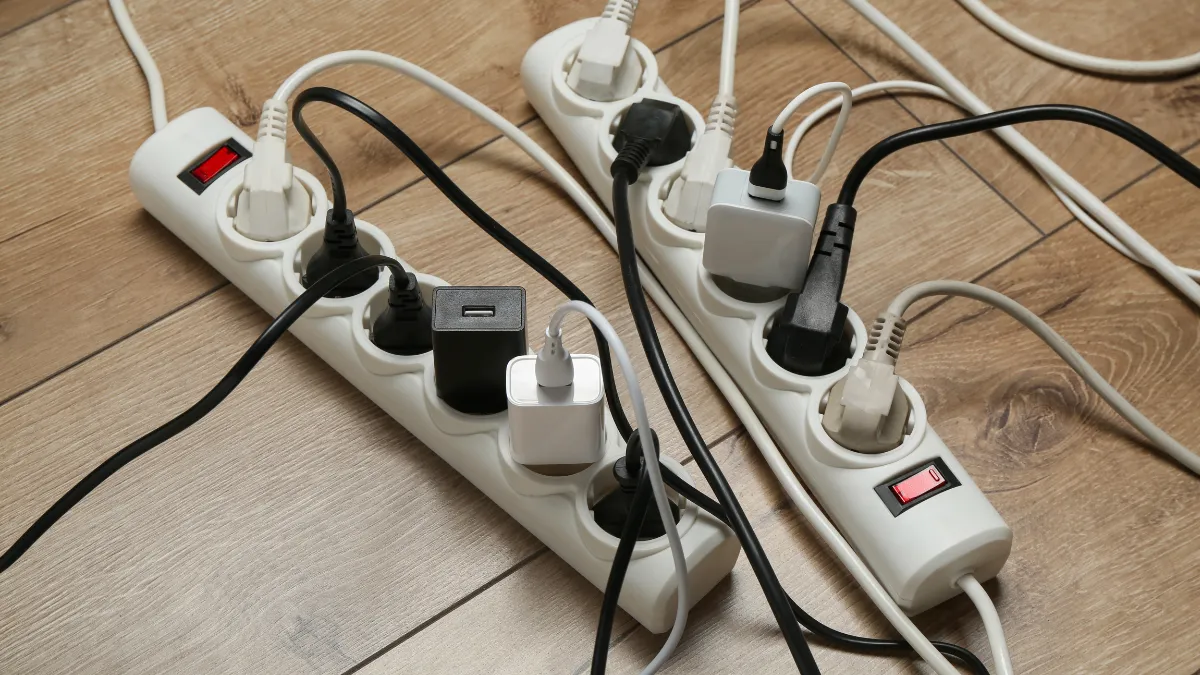
Second, never daisy-chain them. That is a fancy way of saying: do not plug one power strip or surge protector into another one just to get more outlets. It puts too much load on one spot, cancels out the protection, and can start a fire. In fact, most workplaces ban it for that very reason. Out of outlets? The fix is to plug in fewer things, or have an electrician add more outlets. Do not chain strips together.
One thing a surge protector can’t fix
I have to be straight with you here, because it is a safety thing. Even the best surge protector cannot make up for bad wiring in your home or office. If the wiring is not grounded right (that means it does not have a safe path to send extra power into the earth), that is dangerous, both for your gear and for you. And it is not something to poke at yourself. That is a job for a licensed electrician, period. Do your outlets act weird? Do you feel a little shock or tingle when you touch something? Has an older building never had its wiring checked? Bring in a pro. A surge protector is one layer of safety. It is not a fix for bad wiring.
The bottom line
Your surge protector does a quiet, important job. And when it wears out, it does not warn you. It just leaves you unprotected. So do not wait for a sign. Remember that a power strip is not the same as a surge protector. Replace yours every few years, and right away after any big storm. Set that warranty reminder so you are never guessing. And since no protector stops everything, the smartest backup plan of all is a real backup of your files. That way a bad surge is just a hardware headache, never a photo you can never get back. See how to avoid losing your data for that side of it. Stay safe out there this storm season.
Got a computer problem in Durango?
Free assessment, honest answers, you only pay when it’s solved.